
David Callahan was thirty-four when he finally admitted that being an orphan wasn’t a story he could just close the book on.
He grew up in a warm, safe house in a suburb of Minneapolis. His father, Harold, was a high school principal—steady, fair, the kind of man who knew every janitor’s name. His mother, Elaine, was a nurse at a pediatric clinic, and she poured the same gentle patience into David that she gave to frightened children. Summers meant a rented cabin at Lake Mille Lacs, winters meant hockey practice at the local rink. They told him he was adopted when he was seven, sitting him down at the kitchen table with a mug of hot chocolate between them.
“We chose you,” Elaine said, brushing his hair back. “And that makes you ours in every way that matters.”
David nodded, asked for another cookie, and never brought it up again. He had parents. The woman who gave birth to him was just a name on a yellowed sheet of paper, a ghost he never tried to summon.
But the year Elaine died—pancreatic cancer, fast and merciless—something shifted in him. He stood in the cemetery, watching the last clods of dirt fall on her casket, and he kept jamming his hands into his pockets, pulling them out, jamming them back. His father had passed five years earlier from a heart attack. Now the two people who had chosen him, raised him, known him completely, were gone. The silence in their house afterward pressed in on him like a physical weight.
David had built a life, a good one. He restored old motorcycles in a drafty warehouse off University Avenue in St. Paul. Money was okay, friends were around, and his dog Moose was a seventy-pound goof who slept on his bed. He told himself he didn’t need anyone else. But that summer, every time he welded a new bracket or balanced a carb, his brain flicked to the file he kept locked—*Before*.
Who was I before Elaine and Harold?
Six months after the funeral, he hired a guy. Tommy DeSilva, retired police detective with a sandpaper voice and a squint like he was pissed at the sun. David handed over his birth date, the hospital in Duluth, the adoption agency’s faded paperwork. Tommy flipped through, grunted, said, “Gimme three weeks.”
He called back in twelve days.
“Found her,” he said. “She’s still alive. But, uh, you might want to brace yourself.”
David’s heart punched against his ribs. “Where is she?”
“Downtown Minneapolis. Bus station. The Greyhound terminal on Hawthorne.” Tommy paused. “She’s been on the streets a long time. I’m not gonna sugarcoat it. It’s not pretty.”
“I just— I need to see her. Can you take me?”
They met outside the station on a brittle November morning. The air smelled of diesel and wet cardboard. Tommy, lean and weathered, leaned against a parked sedan and fixed David with that squint.
“You sure you’re ready for this?”
“I’m sure.”
“No one’s ever ready.” Tommy rubbed the back of his neck. “I’ve tracked down forty-three people. The reunion you play in your head? Almost never goes that way.”
David just nodded and followed him inside.
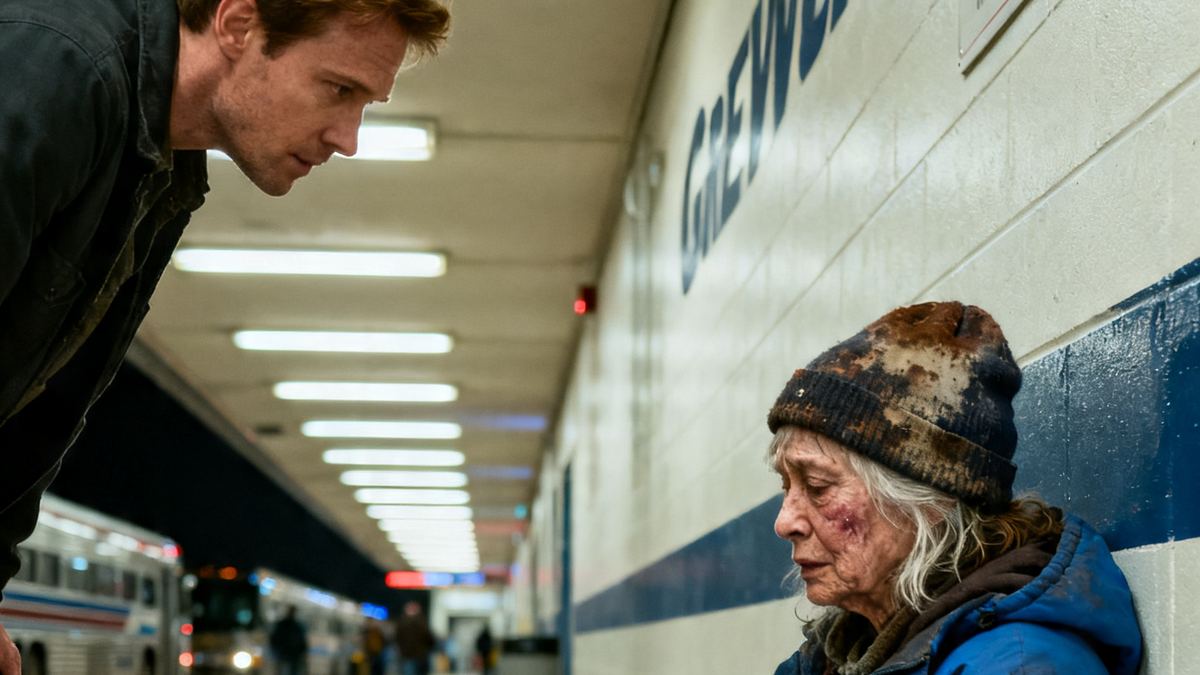
The terminal was a cavern of flickering fluorescent lights and floors that were equal parts gloss and grime. Travelers hurried past, dragging suitcases, staring at phones. Tommy led him down a side corridor, past the ticket counters, to a less-used exit near the back. That’s where the homeless had gathered for warmth. Half a dozen people sat or sprawled against the wall on flattened cardboard, wrapped in sleeping bags and tattered coats. The air was thick with stale sweat, urine, cheap alcohol. A kid with a backpack clipped David’s shin as he ran by, and his mother yelled something in Spanish. David didn’t even flinch.
Tommy stopped and gestured toward a figure huddled in the corner near a heat vent. “That’s her. Blue parka, the one picking at her sleeve.”
David looked.
The woman was a ruin. She might have been sixty or seventy—hard to tell. Her face was swollen and deeply creased, the skin a greyish, papery texture that made her look like something left out in the rain. Her hair, a matted tangle of brown and white, stuck out in clumps from under a stained knit cap. The blue parka had multiple tape repairs on the elbows and a rip along the shoulder. Beside her sat a plastic grocery bag stuffed with what looked like more rags. She was muttering something under her breath, her chapped lips moving in a constant, silent argument.
David felt the floor tilt. He’d imagined a hundred scenarios over the past weeks: a woman in a modest apartment, bitter or maybe remorseful; a tired waitress with his eyes; a stranger who would cry or slap him or refuse to speak. He had never once imagined this.
This woman wasn’t just poor. She had been erased. She was one of those people commuters look past so automatically they might as well be furniture.
And that was his mother.
A wave of nausea rose in his throat. He stood frozen, his polished leather boots rooted to the filthy tile. Every instinct screamed at him to turn and walk out, to go back to his loft, his motorcycles, his dog, and forget this ever happened.
“Want to approach her?” Tommy asked quietly.
David couldn’t answer. He reached into his wallet, pulled out a hundred-dollar bill, and folded it small. “Give her this. Tell her it’s from someone who walked by.”
Tommy accepted the money without comment. He walked over, crouched down, and said something into the woman’s ear. She lifted her head with a slow, stunned motion, as if being addressed directly was a foreign concept. She took the bill with swollen, grime-creased fingers and tucked it into the front of her coat. For a split second, her dull eyes flicked toward David, then away.
He searched her face for any trace of himself. The bridge of his nose? His light eyes? The shape of his jaw? Nothing. She was a complete stranger, connected to him only by a series of bureaucratic checkmarks from thirty-four years ago.
He turned and walked out of the terminal, his shoes clicking too loudly on the floor.
Outside, the cold air slapped his face. Tommy caught up with him a minute later.
“I can’t,” David said, before Tommy could speak. “I’m not ready.”
“Understandable. But, y’know, her health… it’s real bad. Cirrhosis, probably. Mental stuff. She doesn’t have a lot of time.” Tommy pocketed his hands. “You might not get another chance.”
“I’ll figure something out.”
That night, David sat in his armchair with Moose’s head on his knee, staring at the brick wall. He kept seeing her: the torn parka, the muttering, the way she stuffed the money away without curiosity. He tried to conjure a romantic story, some grand tragedy that could justify such a fall. Maybe she was a young college student who got pregnant and was thrown out. Maybe she’d been broken by an abusive partner. But the truth was uglier and simpler: the world had chewed her up and spat her out, and she’d landed there, on that floor, because no one had ever held out a hand for long enough.
He was that hand now, if he wanted to be. He just didn’t know if he could stomach touching her.
A week passed. He worked on a ’76 Bonneville, ordered new cables, met with a supplier. But every time he paused, his mind circled back to the terminal. He called Tommy for an update.
“Same spot,” Tommy said. “A patrol cop I know says she’s been there all month. She sweeps the floor at the station McDonald’s sometimes for tips.”
David drove back the following Tuesday morning, around ten, when the commuter rush had thinned. He found her in the same corner, wrapped in the same blue parka, now with a new strip of duct tape over the shoulder. She was staring at the floor, her back against the wall, a half-empty water bottle beside her.
He approached slow, his throat so tight it hurt. He stopped a few feet away.
“Um, hello,” he said. His voice sounded like a stranger’s.
She didn’t look up. Her fingers were rubbing a torn piece of the cardboard she sat on, back and forth.
“I’d like to, uh, talk to you. If that’s okay.”
Her head lifted. The eyes were watery and unfocused, but there was a flicker of irritation. “You the shelter guy again? I told you people, I ain’t going.”
“No. I’m not from the shelter.” David crouched to her level, the way Elaine used to crouch to talk to a scared child. His knee cracked, loud in the quiet. “I just want to ask you a few things. About your past.”
She let out a sound that might have been a laugh. “My past is dead, son. Nothing there worth digging up.”
“Were you ever married? Did— did you have any… children?”
Now a real gleam appeared in her eyes, a sharper, defensive anger. “What’s it to you? Who sent you? Is this about my benefits? I haven’t gotten benefits in five years, so you can take your questions and…”
“I’m not from the government.” David pulled the adoption paperwork from his coat pocket, unfolded it, and held it out. His hand shook. “Look at this. Please.”
She swatted the paper away. “I can’t read without my glasses, which I don’t have, so you’re wasting your…”
“Listen to me.” His voice cracked. He hadn’t planned on that. “My name is— it’s David. David Callahan. I was born on April eighteenth at St. Luke’s in Duluth. I was… I was given up for adoption three days later. The woman who gave birth to me was named…” He glanced at the paper, even though he knew. “Dorothy Keane.”
The name hung in the air between them.
The woman went very still. Her mouth opened a little, then closed. The muttering stopped. She stared at him with a new kind of intensity, as if she were trying to pull his face into focus through a fog. Then she shook her head, a jerky motion.
“No. No, that baby’s… they took him. It was… no. I ain’t her. Not anymore.” Her voice had gone quiet, thin. “Dorothy… I haven’t heard that name. I don’t… I don’t know that name.”
David’s heart hammered. “It’s you. I think— I think you’re Dorothy. Look, I hired a detective. I’ve been looking for weeks. I’m… I’m your son.”
The silence that followed was worse than any of her anger. A woman pushing a cleaning cart rattled past in the distance. The terminal’s announcement speaker crackled something about a bus to Chicago.
Then Dorothy began to cry.
It wasn’t a dramatic sob, just a thin, strangled sound that seemed to come from somewhere very deep. Her shoulders shook, and she covered her face with both hands, her dirty fingers pressing into her eyes. David stayed crouched, not touching her, his own eyes burning.
“You’re lying,” she whispered through her palms. “You’re lying, that baby’s gone, I gave him up, I never saw him, they said I couldn’t see him, they took him away and…”
“I’m not lying. I have the records. I’ll show you. I just… here.” He thrust the paper toward her again, even if she couldn’t read it.
She dropped her hands and looked at him, her eyes darting from his face to the floor to the exit door, like she was calculating escape routes. Her fingers picked faster at the tape on her sleeve. Then she reached out one trembling hand toward his face, but stopped an inch away, as if touching him might break the spell. “You… you got the cleft chin. My father had that. Oh, God.” She choked on the words. “Oh, God, look at you. Look at you. You’re all grown. You’re real.”
David was crying too now, silently, tears sliding down his cheeks. “I’m real.”
“Why would you come find… this?” She gestured at herself, at the cardboard, the rags, the whole miserable setup. “I’m nothing. I’m trash. You should’ve stayed away.”
“I couldn’t.”
He sat down on the floor beside her, right on the cold, dirty tile, his expensive coat pooling in the dust. He didn’t care. The hem caught on a rivet, and he heard a faint rip—a tear along the seam. He’d worry about the five-hundred-dollar coat later. She watched him, her breath coming in tight, uneven gulps. Her hands kept moving, picking at the sleeve, then twisting a stray thread around her finger.
“I had a boy,” she said finally, her voice steadier but still jagged. “A long time… I don’t remember. April, maybe. They said he was seven pounds and… something. I held him a minute. A nurse put him in my arms and he looked up at me with these big dark eyes. That’s all. Then they took him. I never… I never even named him. They said they’d find him a home, a good home. And I walked out of the hospital and after that… I don’t know. I just… I walked. And I kept walking. Things. Broke.” She swallowed hard. “There was a farm, I think. Cows. My folks… were they already dead? I can’t… there was a man, maybe, but he… I don’t remember. I just remember the baby’s eyes. And I used to talk to you. At night, when I couldn’t sleep. I’d pretend you were somewhere, someplace warm. I’d tell you I was sorry. Over and over. I’m sorry.”
David took a shaky breath. “I was warm and safe. I had a mother and father who loved me. I still do.” He pulled out his phone, flipped to a photo of Elaine and Harold at a backyard barbecue, both gray-haired and beaming. “That’s them. They’re gone now. But they gave me everything.”
Dorothy stared at the screen, her fingers hovering. “They look… kind. They look like… good people.”
“They were.”
He lowered the phone. “I came here because I needed to know where I came from. And I found you. So now, I’d like to help you, if you’ll let me. Not because I feel obligated, but because…” He paused, struggling. “Because you’re my mother. And I can’t just walk away.”
Dorothy’s expression flickered with suspicion—a survival reflex. “Help how? You gonna throw money at me and leave? That’s what people do.”
“No.” David said it firmly. “I already called a place in St. Paul—Aurora House, a home for women who need a restart. Clean beds, counseling, three meals a day. The intake fee is three hundred and forty dollars, and I’ve already covered it. If you want to go, I’ll drive you there right now. And I’ll stay. I’ll visit. I’m not disappearing.”
She squinted at him, suspicion still tightening her jaw. “So I’d be like… a patient? I ain’t a patient.”
“No, it’s a home. You can leave whenever you want. There’s a bus—the 21—stops right outside. It loops downtown every hour and a half. You could be back at the terminal by two-thirty if you decided this isn’t for you. I’m not locking you up.”
She looked at him for a long time, her watery eyes searching his face. “You’d pay three hundred dollars for someone you just met?”
“I’ve known you for thirty-four years,” he said. “I just never knew where to look.”
For the first time, a real laugh escaped her—a hoarse, surprised sound, cut short by a cough. She wiped her nose on her sleeve. “All right. All right.” She began gathering her plastic bags with shaking hands. “I ain’t got much to pack.”
An hour later, David’s truck idled in front of a low brick building with a wheelchair ramp and flower boxes under the windows—Aurora House, stenciled on the sign. Dorothy sat in the passenger seat, clutching her bags on her lap, looking nervously at the building.
“It’s not a shelter?” she asked.
“It’s a home. They’re expecting you.”
A caseworker met them at the door, a cheerful woman with a clipboard and a name tag that said Patricia DeLuca. She didn’t flinch at Dorothy’s appearance. “We’ve got a room on the second floor, window facing the courtyard. Shower’s down the hall, hot water, real towels. Dinner’s at six—meatloaf tonight, with mashed potatoes and green beans. You like meatloaf?” Dorothy just nodded, mute. Patricia led her inside, and David waited in the lobby, a plastic chair under fluorescent lights, Moose’s leash wrapped around his hand (he’d picked the dog up on the way).
When Dorothy emerged an hour later, she looked like a different person. Her hair was still damp, brushed back and bundled into a clean ponytail. She wore donated sweatpants and a soft gray sweater that was a size too big, the sleeves rolled twice. The grime was gone, and she smelled of Ivory soap. There was a glint in her eye that hadn’t been there before.
She walked toward him slowly, like she was testing new floor. “They gave me soup,” she said. “Campbell’s beef and barley. The chunky kind, with crackers. Real good.”
“That’s great.” David stood. “How are you feeling?”
“Like I just woke up from a very long nightmare.” She stared at him, then at the dog. “That yours?”
“Yeah. This is Moose.”
Dorothy reached out and let the dog sniff her hand, then gently scratched his ear. For a moment, she just stood there, patting the shepherd, the tightness in her jaw easing a fraction. Then she looked back at David.
“I’m not gonna be easy,” she said. “I got demons you can’t imagine.”
“I know.”
“And I might… I might screw this up. I’ve screwed up every chance I ever had.”
“Then we’ll try again.” David met her eyes. “You held me for ten seconds and gave me a whole life. Let me give you a shot at one now. That’s all I’m asking.”
She didn’t answer. But she nodded, just once, and her shoulders sagged forward as a long, shaky breath leaked out of her.
He stayed until evening, letting her talk more—scraps about a farmhouse that might have had a red barn, the smell of fresh milk that she still remembered, a mother’s singing voice that she heard sometimes when she closed her eyes. When he finally left, she was sitting in a common room with a mug of Bigelow’s Constant Comment tea, watching the sun set through the window.
The next week, he brought her a photo album with pictures of Elaine and Harold, and later, a small frame with his adoption paperwork displayed. She kept it on her nightstand, beside a half-knitted square of blue yarn. His visits became a routine: Thursdays after work, sometimes Saturdays. He learned she loved crossword puzzles but could never afford a book—so he brought her a Dell pocket-sized book. He learned she had a knack for knitting, and one of the counselors found her a set of needles and a few skeins of Red Heart yarn from the craft bin.
One Tuesday in mid-January, she called him in tears, voice shaking, saying she couldn’t do it, she was going to walk out and go back to the terminal, she didn’t belong here. He drove over after closing the shop, sat with her on the edge of her bed, and didn’t say much, just let her talk until the panic loosened. He didn’t sleep well that night.
Three months later, on a cold February afternoon, he walked into Aurora House with Moose and found her in the garden room, surrounded by other residents, teaching a younger woman how to cast on a scarf. Her hands, still knotted but steadier now, guided the needles. She laughed at something the woman said—a real laugh, raspy but open.
David stood in the doorway, watching. The worry from that phone call still sat in his gut like a cold stone, but here she was. Still here. She looked up, caught his eye, and smiled. It was tired, still a little uncertain, but it was hers.
She waved him over.
He went, Moose padding beside him, and sat down on the bench next to her. The younger woman excused herself, and they were alone. Dorothy held up the half-finished scarf, a messy stretch of blue wool with uneven edges. “I’m making this for you. It’s pretty ugly.”
“I’ll wear it anyway,” David said.
She let out a dry, short laugh. “You know I still might screw this up, right? Just up and leave. Some night I might just… walk.”
“I know.” He reached over and scratched Moose behind the ears. “The bus still runs.”
She looked at him, then at the scarf, then back at him. “I’d freeze my ass off. But I might.”
He nodded. For a moment, neither of them said anything. Snow began to fall outside the garden window, big wet flakes that stuck to the glass, one then another, blurring the parking lot and the empty bus stop.
Dorothy turned the scarf over in her hands, picking at a dropped stitch. “You really gonna wear this thing?” she asked.
“Yeah,” David said. “Every damn day.”