
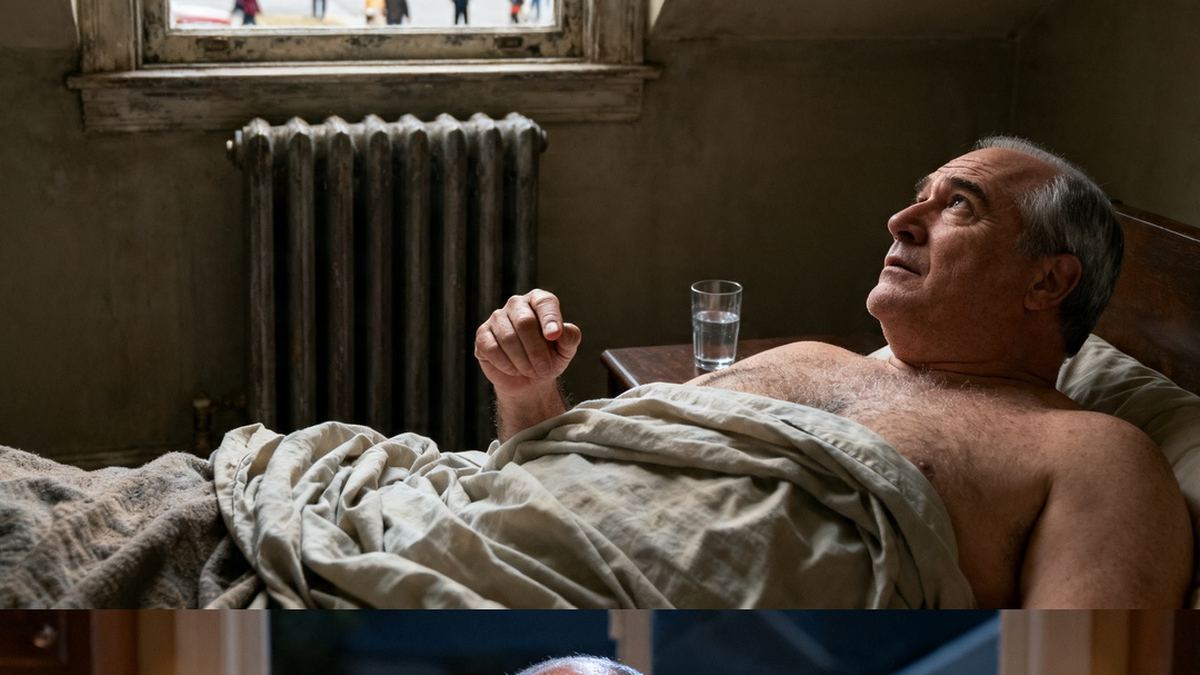
Greg Harlow didn’t believe in sick days. He’d run Harlow’s Muffler & Brake on the edge of Route 9 in Worcester for twenty-two years, usually the first one in and the last one out. But this was a Tuesday in late November, and he’d been flattened by something worse than any hangover he’d ever had. The flu hit him like a bag of concrete dropped from a second-story window. By Wednesday morning, he couldn’t get out of bed without his legs buckling. His phone buzzed a few times—a couple of suppliers, a robo-call about his car’s extended warranty—but nobody he could ask to bring him a can of soup. His son was stationed at a base in Colorado. The guys at the shop were good, but they were employees, not family. He didn’t want to be a burden.
For two days, he just lay there, running a fever that made the ceiling tiles ripple. He could feel his body eating itself, the dehydration pulling his skin tight over his cheekbones. He was on the third floor of an old triple-decker on May Street, and the stairs might as well have been the face of El Capitan. He was alone with the hum of the ancient radiator and the slow, creeping thought that a man his age shouldn’t be this invisible.
On the fourth day, a knock landed on his door. A light, hesitant tap that sounded like someone was afraid of denting the wood. Greg tried to shout "Come in," but it came out as a dry croak. He heard the scratch of a key in the lock. For a split second of feverish panic, he thought it was a break-in, but then a voice called out from his kitchen.
"Mr. Harlow? It’s Walter, from downstairs. I hadn’t seen your truck move, and the light in the bay’s been off. You okay?"
Walter Finch. The man who lived in the garden-level apartment. Greg had bought the building ten years ago and Walter had come with it, a legacy tenant so quiet he was practically a ghost. He was a retired history teacher, a widower in his late seventies, always dressed in corduroy pants and a faded Red Sox cap. Their conversations in the hallway over the last decade had never gone deeper than the weather or whether the trash bins had been taken to the curb. A nod. A grunt about the Sox bullpen. That was it.
Walter appeared in the bedroom doorway, holding a brown paper bag from the Price Chopper on Cambridge Street.
"Jeez, you look like death warmed over," Walter said, his voice dry as autumn leaves. "I’m going to put some tea on. You just stay put."
Greg didn't have the strength to argue. He drifted in and out of a feverish sleep, aware only of the muted sounds from his own kitchen. The clink of a spoon against a ceramic mug. The soft rush of a faucet. The gentle, deliberate click of a cabinet door being closed with two hands to avoid a loud bang.
For the next five days, Walter came up every evening at six-fifteen. He’d let himself in, heat up a container of chicken stew or minestrone from a batch he’d made downstairs, and set it on a TV tray next to Greg’s bed. He’d refill the water pitcher, check the thermostat, and stack the day’s mail on the dresser, the junk mail already recycled. He never lingered, never pried. He just moved around the apartment with an economy of motion that came from years of living alone, rearranging the chaos of a sick man’s life back into order. Once, Greg woke up in the middle of the night and saw that Walter had even re-strung the broken pull-chain on the bedside lamp.
Greg didn’t know why. They weren’t friends. They were two men who happened to share a front door. You don’t pay that kind of debt forward for a few minutes of small talk about a frozen downspout.
A week in, the fever finally broke. Greg woke up at four in the morning, his sheets soaked with sweat, but his head was clear. He was so grateful to feel like a human being again that he almost wept. He took a hot shower, pulled on a clean sweatshirt, and made his way out to the living room for the first time in what felt like a century.
The place was spotless. Not just tidy, but deeply clean, the kind of clean that gets into the grout. The pile of old *Hemmings Motor News* magazines that had been scattered on the coffee table was squared into a perfect stack. The layer of dust on the TV stand was gone. But what stopped him cold was the item on the kitchen counter, next to the toaster.
It was an old, yellowed invoice, held flat by a refrigerator magnet shaped like a spark plug.
Greg squinted, his hand trembling slightly as he picked it up. It was a receipt from his own shop, dated March of 2008. Fifteen years ago. The customer copy was still attached, with carbons smudged but legible. It was for a tailpipe and muffler install on a 2004 Honda Accord, listed at $340. But across the bottom, in his own block-letter handwriting, he read the words "NO CHARGE" and his initials.
He had absolutely no memory of it. Zero. He’d written off a hundred little jobs like that over the years, for single mothers, for kids down on their luck, for anyone who needed a break. It was just what you did when you owned a shop in a working-class town. You tightened a bolt, you looked the other way on the bill, and you forgot about it ten minutes later.
He heard the key in the deadbolt. Walter walked in, holding a bag of takeout from the diner down the street. He froze when he saw Greg holding the magnet to the light.
The silence stretched for a long moment.
"You kept the invoice," Greg said. It wasn't a question.
Walter set the bag of food on the counter and slowly took off his cap. He ran a liver-spotted hand over his thin white hair.
"I had a wife you never met," Walter said, his voice quiet, almost a monotone, as if he were reading from a book he knew by heart. "Alice. She was sick for a long time. Brain cancer. I’d cashed out the 401(k), took a second mortgage on a house in Shrewsbury, sold the boat. Everything. When she finally passed, I was over a hundred-and-fifty grand in the red and the bank was looking to take the house. I was broke, running overdue notices for a car with an exhaust leak so bad you could smell it in the cabin."
He nodded toward the invoice in Greg’s hand.
"It was snowing. Two days before Christmas. I limped the car into your shop hoping for a miracle, and you told me you’d 'take a look.' An hour later, you came back into the waiting room, tossed me my keys, and said, 'Merry Christmas. The whole exhaust is going to fall off if you don't put a clamp on it, but that muffler was toast, so I swapped it. Don't worry about it.'"
Greg slowly lowered himself into a kitchen chair. There was a faint bell ringing in the back of his memory. A gaunt man in an overcoat that was too thin for the weather. He remembered the guy’s eyes, hollowed out from grief, staring at the grease-stained floor.
"I never forgot your face," Walter said. "But you clearly forgot mine. That’s okay. It’s different, being the one who needs the help. When I saw the ad that you were looking to sell this building five years later, I’d just gotten back on my feet. I took the apartment the same day. I thought, 'I’m going to live right underneath him, and one day, he’ll need a hand, and I’ll be able to even the scales.'"
He gestured vaguely at the apartment.
"It took a decade, but you finally got sick."
Greg stared at the invoice, the paper shaking. He wasn't looking at a receipt for a muffler. He was looking at a man's entire strategy for dealing with a debt that couldn't be repaid with money. For fifteen years, Walter had been living in the floor below him, silently waiting, keeping his ear tuned to the specific frequency of Greg’s pickup truck starting up every morning.
"But it was just a tailpipe," Greg whispered, his voice cracking.
Walter looked him right in the eye. "No," he said gently. "It was a fixed car the week before Christmas. It was knowing you weren't totally invisible to the world."
The old man picked up the bag of takeout and pulled out two containers of clam chowder.
"Now eat your soup before it gets cold," Walter said. "You still look like hell."
Greg let out a shaky breath that was half a laugh, half a sob. He took a spoon, the cheap plastic bending slightly in his grip.
The radiator hissed in the corner, filling the silence. Two men sat at a kitchen table on a cold Tuesday night, eating chowder out of Styrofoam cups, a fifteen-year-old exhaust invoice held flat between them by a magnet shaped like a spark plug.